Understanding Your Consumer Confidence Report: A Scientific Approach to Drinking Water Safety
Every summer, community water suppliers across the United States are legally mandated to deliver a Drinking Water Quality Report—formally designated by the U.S. Environmental Protection Agency (EPA) as a Consumer Confidence Report (CCR)—to all billing customers. For the average homeowner or tenant, this multipage technical document can read like an impenetrable wall of regulatory abbreviations, chemical nomenclature, and statistical ranges. Yet tucked inside these tables lies critical empirical data regarding systemic water safety, chemical treatment protocols, and, most crucially, heavy metal exposure metrics such as dissolved and particulate lead.
While municipal utilities invest heavily in coagulation, sedimentation, filtration, and disinfection to produce potable water that complies with National Primary Drinking Water Regulations, the journey of municipal tap water does not end at the treatment plant gate. Understanding how to interpret the numerical values, percentile indicators, and legal thresholds reported in your CCR is an essential skill for protecting your household against long-term toxicological hazards. Navigating these reports requires a foundational knowledge of water chemistry, plumbing metallurgy, and regulatory mechanisms, which we frequently explore across our educational environmental health resources.
The Biology of Lead Toxicity and Why Water Metrics Matter
Lead (chemical symbol Pb) is a potent, non-threshold neurotoxin with no known biological benefit in human physiology. Once ingested through contaminated water or airborne particulates, inorganic lead is rapidly absorbed into the bloodstream via the gastrointestinal tract. In adults, roughly 10% to 15% of ingested lead is absorbed, but in infants, toddlers, and pregnant women, that absorption efficiency can escalate dramatically to between 40% and 50%. The biological mechanics of lead toxicity stem from its capacity to act as a molecular mimic of divalent calcium (Ca2+) and zinc (Zn2+).
By substituting for calcium across biological membranes, lead easily crosses the blood-brain barrier. It binds avidly to calcium-dependent enzyme sites, disrupts protein folding, triggers mitochondrial oxidative stress, and impairs neurotransmitter release mechanisms—specifically acetylcholine and dopamine signaling. In developing pediatric brains, this toxicity causes irreversible cognitive deficits, diminished executive functioning, shortened attention spans, and neurobehavioral abnormalities. In adults, chronic low-level lead accumulation correlates directly with renal impairment, vascular endothelial dysfunction, hypertension, and adverse cardiovascular events.
Because lead bioaccumulates within mineralized tissues—depositing deep into bone cortical matrices where its biological half-life exceeds 20 to 30 years—daily cumulative ingestion represents a profound public health concern. Drinking water contributes an estimated 20% or more of total human lead exposure in adults, and upwards of 40% to 60% in formula-fed infants whose powdered nutrition is reconstituted using municipal tap water. Consequently, decoding your local CCR is not merely a bureaucratic review; it is an active preventative health measure.
Deconstructing the CCR: Regulatory Definitions and Acronyms
To extract meaningful intelligence from a Consumer Confidence Report, you must first master the specialized terminology governing primary drinking water standards. Municipal compliance reports organize chemical and radiological data within standardized matrix tables, typically featuring the following regulatory headings:
Maximum Contaminant Level Goal (MCLG): The non-enforceable health benchmark set at the level of a contaminant in drinking water below which there is no known or expected risk to human health. MCLGs incorporate substantial margins of safety. For carcinogenic compounds and non-threshold systemic toxins like lead, the EPA has established the MCLG strictly at zero (0 ppb). Any reported exposure level above zero represents a theoretical biological risk.
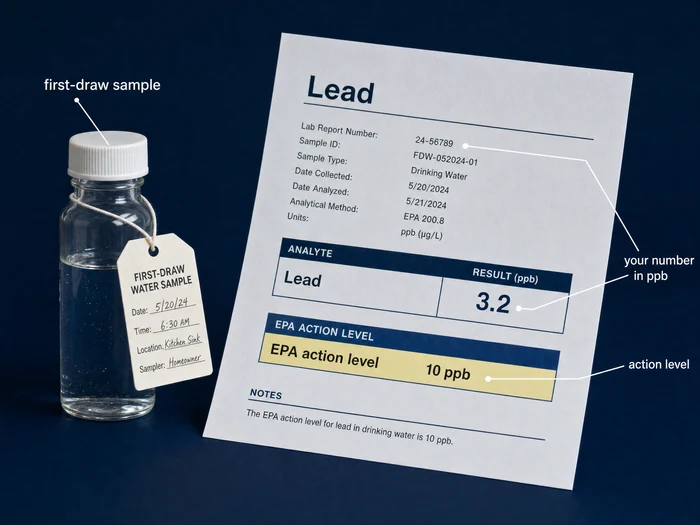
Maximum Contaminant Level (MCL) vs. Action Level (AL): While most chemical contaminants (such as arsenic, benzene, or trihalomethanes) have an enforceable numeric ceiling known as an MCL, lead and copper are managed under a distinct regulatory regime established by the 1991 Lead and Copper Rule (LCR). Because lead rarely originates within centralized municipal treatment facilities, the EPA established an Action Level (AL) of 15 parts per billion (ppb), or 0.015 milligrams per liter (mg/L). An Action Level is not an absolute safety threshold; rather, it is a legal trigger mechanism requiring specific operational responses.
Parts Per Million (ppm) vs. Parts Per Billion (ppb): Concentration units dictate the severity of water contamination. One ppm represents one milligram of contaminant per liter of water (mg/L), equivalent to one drop of water in forty gallons. One ppb represents one microgram per liter (μg/L), roughly equivalent to one second in nearly thirty-two years. Because heavy metals cause systemic damage at minute physiological concentrations, lead concentrations are universally recorded in parts per billion (ppb) or μg/L.
The 90th Percentile Rule: What the Compliance Numbers Really Signify
When you locate the lead row within your CCR’s water quality data table, you will immediately notice that the utility does not publish a simple arithmetic average. Instead, federal standards require utilities to calculate and publish the 90th percentile value derived from targeted compliance sampling across their distribution service territory.
To establish this figure, the public water utility conducts periodic sampling events targeting a statistically predetermined pool of high-risk residential properties—predominantly homes served by known utility-owned lead service lines, lead goosenecks, or containing interior plumbing installed prior to the 1986 Safe Drinking Water Act lead ban. After collecting first-draw samples following a minimum six-hour stagnation interval, the analytical lab tests each sample via Inductively Coupled Plasma Mass Spectrometry (ICP-MS). The laboratory results are subsequently sorted in ascending order from lowest concentration to highest concentration.
The 90th percentile is the specific numerical reading below which 90 percent of the monitored sites fell. For instance, if a municipal system collects 100 household samples, the results are listed from 1 to 100, and the value of sample number 90 becomes the official regulatory metric printed in your CCR. If that single 90th percentile data point equals or exceeds 15 ppb (or 10 ppb under modern revised Lead and Copper Rule improvements), the entire municipal utility fails compliance, triggering mandatory public notifications, corrosion control optimization, and accelerated lead service line replacement programs.
However, this statistical methodology carries a critical implication: up to 10 percent of the sampled residences can harbor lead levels dramatically exceeding the Action Level without the utility violating federal regulatory thresholds. A compliant 90th percentile rating of 6 ppb does not verify that every tap across the municipal distribution network delivers lead-free water. If your private plumbing contains legacy lead solders, brass fixtures, or private service pipes, your domestic concentrations could sit well within that elevated 10 percent window. Property owners seeking individual verification often schedule specialized investigations such as lead water inspection and testing in Manhattan to identify premise-level contamination risks that municipal averages inherently obscure.
Chemical Mechanics: Water Aggressiveness and Infrastructure Degradation
Understanding the data in a CCR requires examining why lead enters municipal tap water in the first place. Drinking water distributed by municipal treatment plants is virtually free of lead when leaving the filtration plant. Contamination is almost exclusively the result of pipe corrosion—an electrochemical reaction occurring within the subsurface distribution network and internal premise plumbing.
Three primary variables determine water aggressiveness and lead leaching capacity: pH, alkalinity, and the presence of protective corrosion inhibitors. When water exhibits a low pH (acidic) or insufficient carbonate buffering capacity, it acts as an aggressive solvent, oxidizing metallic plumbing materials. Water utilities actively manage this dynamic through corrosion control treatment (CCT), typically dosing food-grade orthophosphates into the treated effluent. Orthophosphates react chemically with dissolved lead ions to produce an insoluble, passivating mineral layer (predominantly hydroxylpyromorphite) along the interior pipe wall, effectively insulating moving water from raw metal surfaces.
Your CCR routinely details secondary distribution metrics that shed light on this chemical balance, including secondary drinking water indicators like pH, total dissolved solids (TDS), and residual disinfectant concentrations. If a municipal utility changes its raw water source or alters its primary disinfectant—such as shifting from free chlorine to chloramines without properly recalibrating corrosion inhibitor dosing—the passivating protective crust can destabilize, causing catastrophic spikes in particulate and colloidal lead release into consumer taps.
Furthermore, physical disturbance of subsurface infrastructure can cause mechanical shearing of interior mineral scales. Road excavation, water main replacement, or localized residential modernization can jar buried service pipes, dislodging concentrated lead particles into domestic water lines. If your home underwent renovation, you may already be familiar with environmental safeguards like the EPA Renovation, Repair, and Painting Program, which regulates airborne lead dust hazards; similar rigorous precautions must be applied to physical water infrastructure to prevent acute heavy metal surges.
The Boundary of Responsibility: Utility vs. Private Premise Plumbing
One of the most widespread misconceptions among residential property owners is the belief that a stellar municipal CCR guarantees that their domestic water is pristine. A Consumer Confidence Report documents the performance of public distribution infrastructure and representative sampling pools; it cannot account for internal structural variations within private buildings.
The pathway from the municipal main to a drinking water tap is divided across clear legal and physical boundaries:
1. Utility Water Main: The large-diameter public carrier line situated beneath municipal roadways (typically constructed of ductile iron, concrete, or modern polymers).
2. Public Service Line: The buried pipe running from the water main to the curb stop or property boundary, traditionally owned and operated by the water utility.
3. Private Service Line: The continuous pipe traversing private property from the curb shutoff into the basement or water meter, owned exclusively by the property owner.
4. Internal Premise Plumbing: The intricate matrix of risers, horizontal distribution pipes, valves, solders, and end-use fixtures throughout the interior building envelope.
Even when a public utility completes full utility-side lead line abatement, legacy private infrastructure often remains unaddressed. Homes constructed prior to 1986 frequently feature copper lines joined by 50/50 tin-lead solder alloys. Furthermore, prior to federal standards enacted in January 2014 under the Reduction of Lead in Drinking Water Act, plumbing brass fixtures and valves marketed as “lead-free” were legally permitted to contain up to 8% lead by weight. Today’s standard limits the wetted surface lead content to a weighted average of 0.25%, meaning older brass faucets continue to pose localized leaching risks during stagnation.
Residents reliant on decentralized systems must exercise even greater individual vigilance. Because private domestic wells are not connected to public municipal utilities, they are not governed by federal reporting statutes, and property owners do not receive annual CCRs. Guidance outlined by the EPA Private Drinking Water Wells division emphasizes that private well owners bear sole responsibility for conducting analytical testing for biological pathogens, volatile organics, and corrosive heavy metals.
Actionable Verification and Protective Protocols
Reviewing your Consumer Confidence Report is the foundational diagnostic step in environmental self-advocacy. If your local utility reports elevated 90th percentile metrics, or if you reside in a pre-2014 property, you should execute a structured hierarchy of practical, evidence-based protective actions:
Perform Objective Material Audits: Inspect the primary water service entrance where the main line penetrates your foundation or mechanical room. Scratch the exterior of the pipe gently with a coin or key; if the bare metal is soft, turns bright silver, and a magnet will not adhere to it, you are likely inspecting a lead service line. Conversely, rigid piping that attracts a magnet indicates galvanized iron (which can capture and continuously re-release legacy lead), while shiny orange surfaces denote copper.
Conduct Independent Laboratory Profiling: Because municipal CCRs only reflect pooled statistical representations, validating private property safety requires empirical laboratory analysis. Establishing your environmental safety margin requires standardized water baseline testing to capture both initial stagnation draws (identifying faucet fixture and solder leaching) and fully purged sequential draws (isolating service line contributions). For answers to common procedural questions regarding sampling turnaround times and laboratory parameters, consulting an environmental testing testing FAQ helps streamline the diagnostic process.
Implement Systematic Flushing Routines: Water that has sat motionless in internal plumbing for more than six hours absorbs maximum concentrations of leached metals. Always flush your drinking water lines by operating the cold-water faucet at full force until the water turns noticeably colder—typically 1 to 3 minutes—prior to drawing water for consumption or cooking. Never utilize hot tap water to prepare baby formula, tea, or food, as heat significantly accelerates internal chemical leaching.
Deploy Certified Point-of-Use (POU) Filtration: If plumbing replacement is not immediately feasible, install filtration hardware verified by independent standards organizations. Ensure your carbon block, reverse osmosis, or ion-exchange filtration units carry explicit certifications under NSF/ANSI Standard 53 (Health Effects) or NSF/ANSI Standard 58 (Reverse Osmosis) specifically validated for lead reduction. Routine sediment filters and generic aesthetic pitchers certified only under NSF/ANSI Standard 42 reduce chlorine and taste compounds, but provide zero protection against dissolved lead.
By transforming complex technical data from your annual Consumer Confidence Report into targeted home inspection and remediation protocols, you insulate your household against invisible chemical contaminants. For comprehensive breakdowns of emergent municipal regulations, environmental risk modeling, and advanced home remediation strategies, read through our ongoing analytical series on our environmental safety blog.