Lead Pipes vs. Copper Pipes: Which Is Safer for Your Family?
When evaluating residential infrastructure, few components have as profound an effect on household health as the materials conveying your daily potable water. For decades, plumbing engineering evolved through trial, error, and emerging toxicology. Today, property owners and tenants frequently ask a critical question: when comparing aging lead plumbing to modern copper systems, which material is truly safer for your family? Understanding the distinction requires examining material chemistry, cellular toxicology, national infrastructure directives, and rigorous testing methodologies that go beyond basic visual assessments.
Historically, lead was prized for its malleability, corrosion resistance, and ductility. Municipalities across the United States installed millions of lead service lines from the late 19th century through the mid-20th century. Conversely, rigid copper pipe emerged in the post-World War II housing boom as a durable, cleaner alternative. While modern plumbing codes strictly prohibit lead distribution lines, legacy installations remain buried under hundreds of thousands of homes. Learning how these metals behave under persistent municipal flow is essential to protecting domestic wellness, a core priority shared by the health advocates at A Safe Tomorrow.
The Chemical & Physical Comparison: Lead vs. Copper
To understand the safety profiles of these materials, one must examine their physical properties and electrochemical characteristics. Lead (atomic symbol Pb) is a dense, soft, dull-gray metal that can be easily scratched or indented with a coin or key. Because of its low melting point and flexible matrix, municipal engineers historically bent lead conduits around underground boulders, foundation walls, and root networks without specialized fittings. However, lead is inherently prone to galvanic corrosion and chemical leaching whenever the surrounding water chemistry turns acidic or lacks mineral hardness.
Copper (atomic symbol Cu), by comparison, is a reddish-brown transition metal recognized for its high tensile strength, rigid structure, and exceptional heat conductivity. In residential plumbing, copper is installed as rigid tubing connected by soldered capillary fittings or mechanical press joints. Under balanced water conditions, copper naturally oxidizes into a stable internal protective patina composed of cuprous oxide (Cu2O) and basic copper carbonate. This passivating barrier shields the underlying metal from corrosive dissolution, preventing metal migration into the passing flow.
The primary failure mode of lead plumbing is not structural rupture, but chronic surface erosion and particulate shedding. When water utilities adjust treatment processes, alter disinfectant regimens, or fail to inject orthophosphate corrosion inhibitors, the protective mineral crust inside lead conduits destabilizes. This deterioration discharges toxic divalent lead ions (Pb2+) and sub-micron particulate flakes directly into residential faucets. Copper lines can also degrade under aggressive, highly acidic water (pH below 6.5) or through excessive hydraulic velocities, but copper forms resilient boundary layers far more reliably than toxic heavy metals.
Biological Safety & Human Health Impacts
From a biochemical perspective, lead and copper occupy completely opposite classifications in human physiology. Copper is an essential biological trace micronutrient required for cellular enzyme function, iron metabolism, and connective tissue synthesis. The human body maintains sophisticated homeostatic pathways to regulate, utilize, and excrete dietary copper through hepatic biliary filtration. In contrast, lead possesses zero biological utility in the human organism; it is a non-threshold neurotoxin capable of causing cellular damage at undetectable serum concentrations.
When ingested through contaminated tap water, soluble lead mimics essential divalent cations, primarily calcium (Ca2+) and zinc (Zn2+). By hijacking voltage-gated calcium channels, lead crosses the blood-brain barrier and disrupts synaptic neurotransmission, triggering cellular apoptosis, mitochondrial failure, and widespread oxidative stress. In infants and young children, even minimal exposures cause permanent cognitive impairment, reduced IQ, behavioral deficits, and delayed neurodevelopment. In adults, chronic low-level ingestion contributes to systemic hypertension, renal impairment, and cardiovascular disease.
Because heavy metals accumulate in bone tissue over lifetimes, prolonged exposure creates endogenous reservoirs that can remobilize during pregnancy, lactation, or advanced age. Detailed clinical guidance regarding lead accumulation reveals that skeletal stores release legacy deposits back into the bloodstream during periods of physiological remodeling. Conversely, excessive copper consumption, while capable of inducing acute gastrointestinal distress or liver complications under extreme conditions, rarely stems from passive pipe dissolution in properly managed municipal supplies.
For multi-unit landlords and residential managers seeking to confirm that domestic distribution loops are free from neurotoxic contaminants, contracting professional building water testing in NYC delivers the laboratory precision necessary to detect microgram-per-liter heavy metal contamination across vertical risers.
Infrastructure Standards & Federal Regulations
The regulatory landscape governing residential water distribution has evolved significantly over the past half-century. Recognizing the severe public health hazards posed by metallic leaching, the United States Congress established statutory frameworks to enforce drinking water purity from source to tap. Central to this defense is the landmark Safe Drinking Water Act, which authorizes the Environmental Protection Agency (EPA) to establish National Primary Drinking Water Regulations for chemical, biological, and radiological contaminants.
In 1986, federal amendments banned the installation of pipes, fittings, or solder containing more than 8% lead in public systems and residential plumbing, later refined to strict “lead-free” definitions capping wetted lead content at 0.25% in 2014. To manage the millions of pre-existing lines, the EPA promulgated the Lead and Copper Rule (LCR) in 1991. The LCR established regulatory action levels based on 90th-percentile municipal monitoring: 15 parts per billion (ppb) for lead and 1.3 parts per million (ppm) for copper. Notably, the revised Lead and Copper Rule Improvements (LCRI) mandate lowering the lead action level to 10 ppb and require water utilities nationwide to inventory and replace all legacy lead service lines within a decade.
Water suppliers must maintain chemical stability to prevent leaching throughout distribution networks. Water providers utilize lime softening, sodium hydroxide addition, and orthophosphate dosing to maintain alkaline pH levels and precipitate protective mineral coatings along pipe interiors. Public accountability is reinforced through mandatory annual reporting; consumers can scrutinize local compliance benchmarks and detected metal concentrations by reviewing their public utility’s official Consumer Confidence Report.
In dense metropolitan sectors where centuries-old infrastructure intersects modern private distribution systems, property owners frequently commission private water testing in Queens to independently verify whether municipal service connections, property boundary tie-ins, or interior brass solder joints are discharging contaminants into household fixtures.
Identifying Lead vs. Copper Pipes in Your Home
Determining whether your residence relies on lead or copper conduits requires careful physical inspection at the point where the main service pipe enters the structure—typically in a basement, crawlspace, or utility closet before the water meter. Homeowners can perform preliminary field tests to categorize suspect plumbing using simple household tools:
1. The Visual & Scratch Test
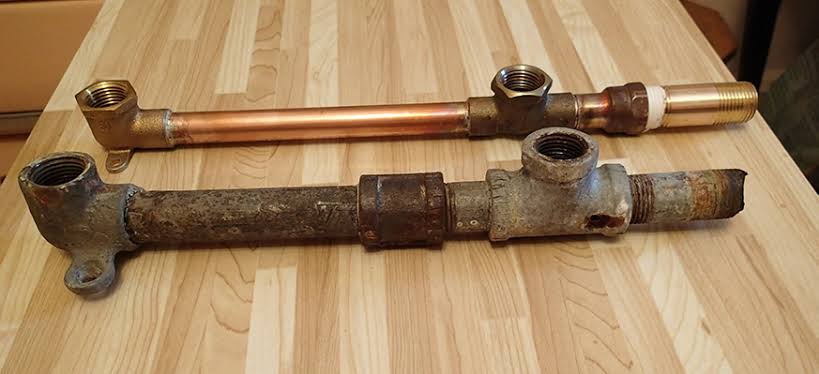
Examine the exposed pipe entering the foundation. Lead pipes exhibit a dull, matte gray surface that tarnishes over time. Using an ordinary key or flathead screwdriver, gently scrape the exterior surface. If the pipe is lead, the scraped area will shine with bright, silvery luster and yield easily to mechanical pressure because of the metal’s natural softness. Copper pipes, by contrast, display a distinctive warm metallic penny hue, often speckled with greenish-blue surface oxidation, and will resist scratching without leaving deep gouges.
2. The Magnet Test
Hold a standard refrigerator magnet directly against the conduit wall. Neither lead nor copper is ferromagnetic; therefore, a magnet will not stick to either material. If the magnet adheres firmly to the pipe surface, the line is manufactured from galvanized iron or steel rather than lead or copper. Keep in mind that older galvanized pipes frequently trapped dissolved lead flakes shed from upstream municipal mains, making them indirect heavy metal hazards.
3. Physical Architecture & Junction Geometry
Examine the joints where fittings connect. Lead service pipes frequently feature a rounded, bulbous swelling known as a “wiped joint” where individual segments were soldered together by historical plumbers using molten lead alloys. Copper distribution lines, conversely, utilize clean, streamlined angular elbows, tees, and couplings bonded with neat solder rings or modern mechanical crimp rings.
While visual inspections clarify the primary intake line, they cannot detect internal plumbing anomalies. Many mid-century homes built with rigid copper pipes still harbor dangerous lead concentrations due to 50/50 tin-lead solder applied to joints prior to the 1986 federal ban, or through vintage brass fixtures containing high lead percentages. You can explore our comprehensive technical library and downloadable homeowner guides within our educational resources to better navigate structural assessments and historical building standards.
Empirical Testing: The Only Definitive Diagnosis
Because lead and dissolved copper are entirely colorless, odorless, and tasteless at concentrations capable of causing biological injury, physical inspection alone cannot confirm that your domestic water is safe. Empirical laboratory analysis remains the sole scientifically defensible method for measuring heavy metal exposure in residential drinking water.
Comprehensive domestic testing protocols typically employ a two-tiered sampling strategy executed through an environmental testing laboratory accredited by the National Environmental Laboratory Accreditation Program (NELAP):
First-Draw Sampling
This protocol requires collecting a one-liter sample immediately after the plumbing system has remained completely stagnant for a minimum of six to eight hours, typically early in the morning. First-draw sampling captures metals that leached directly from the fixture, interior brass valves, and nearby copper joints soldered with legacy lead alloys during overnight contact.
Flushed (Purged) Sampling
After the first-draw sample is secured, the faucet runs at full velocity for two to three minutes until a distinct drop in water temperature confirms that fresh municipal water from the buried street main has reached the tap. A second sample is then gathered. If the flushed sample exhibits elevated lead counts, the primary source of contamination is almost certainly the external service line or municipal gooseneck buried outside the home footprint.
Certified laboratories process these samples using Inductively Coupled Plasma Mass Spectrometry (ICP-MS), an advanced analytical technique capable of quantifying elemental lead and copper down to parts-per-trillion (ppt) thresholds. Comparing these empirical findings against health benchmarks establishes whether your family requires immediate physical line replacement or targeted point-of-use mitigation.
Protective Protocols: Immediate & Long-Term Solutions
If analytical testing reveals elevated lead levels or aggressive copper leaching within your domestic distribution network, families should implement a hierarchical protection strategy consisting of immediate exposure mitigation and permanent infrastructure remediation:
1. Cold-Water Operational Disciplines: Always draw cooking and drinking water from the cold tap. Hot water aggressively accelerates the chemical dissolution of heavy metals from solder matrices and pipe walls, while water heaters concentrate settled metallic sediments over time. Boiling water does not remove heavy metals; it concentrates them as pure water evaporates away.
2. Systematic Stagnation Flushing: If plumbing has sat unused for six hours or more, run the kitchen faucet on cold for one to two minutes before collecting water for consumption. To conserve municipal resources, this flushed water can be captured to irrigate household ornamental plants.
3. Certified Point-of-Use Filtration: Deploy drinking water filtration devices specifically tested and certified under NSF/ANSI Standard 53 for health effects (specifically heavy metal reduction) or NSF/ANSI Standard 58 for reverse osmosis. Basic aesthetic carbon pitchers certified solely under NSF/ANSI Standard 42 will not reliably capture dissolved lead ions or sub-micron particulate suspensions.
4. Full Infrastructure Abatement: While filtration provides vital interim safety, the only permanent remedy for lead piping is comprehensive service line replacement. Homeowners must coordinate with local utilities to execute full replacements from the municipal water main into the interior meter, utilizing modern Type K copper tubing or certified cross-linked polyethylene (PEX-a). Partial replacements—wherein only the utility-owned or privately-owned section is swapped—must be strictly avoided, as coupling dissimilar metals induces rapid galvanic corrosion that dramatically spikes lead concentrations for months following excavation.
Navigating residential plumbing hazards requires proactive vigilance, empirical testing, and evidence-based remediation. By identifying line compositions, reviewing municipal disclosures, validating tap purity through certified laboratory analysis, and replacing legacy materials, you establish an uncompromising barrier between hazardous environmental toxins and your family’s daily drinking supply. If you suspect your plumbing contains legacy materials or require expert guidance interpreting environmental laboratory results, please contact our team to safeguard your residential environment today.