Can a Water Filter Remove Lead? What to Look For
The short answer to whether a water filter can remove lead is yes, but with an indispensable caveat: not all water filters are capable of doing so. While standard countertop pitchers and refrigerator filters excel at reducing chlorine taste and odor, many basic models do nothing to filter out dissolved heavy metals. Lead is an invisible, odorless, and tasteless contaminant that poses severe neurotoxic risks at any concentration. Determining whether a specific filtration system will protect your household requires understanding the nature of lead contamination, the mechanisms behind certified filtration media, and the rigorous empirical standards established by independent public health testing bodies.
When evaluating point-of-use or whole-house treatment devices, relying on generic manufacturer marketing is dangerous. The public health consensus is unequivocal: physical sieves cannot reliably capture microscopic chemical threats without specialized kinetic degradation, ion exchange, or semipermeable molecular separation. Before investing in any water filtration system, homeowners must grasp the physics of plumbing degradation, standard verification certifications, and practical operating protocols necessary to keep heavy metal concentrations strictly suppressed at the tap.
The Physics and Biochemistry of Lead in Municipal Water
Unlike chemical runoff or biological pathogens that enter drinking supplies directly at source reservoirs, lead contamination is predominantly a localized infrastructure failure. Municipal water treatment facilities typically deliver water that meets federal standards directly to city distribution mains. However, as treated water travels through aging distribution networks, it encounters public service lines, private service laterals, copper pipes joined with lead-bearing solder, and legacy brass or bronze fixtures manufactured before modern lead-free plumbing standards were enacted.
Water characteristics such as pH, dissolved oxygen, and mineral hardness determine its corrosiveness. When municipal utilities fail to maintain optimal chemical corrosion control—often through the dosing of orthophosphate to build a protective passivation coating inside pipes—leaching occurs. Lead enters the water supply in two distinct chemical and physical forms: dissolved lead and particulate lead. Dissolved lead consists of microscopic free ions ($Pb^{2+}$) bonded uniformly into the aqueous solution. In contrast, particulate lead comprises tiny fragments sheared from aging pipe walls, flaking solder, or deteriorating galvanized iron. Because particulate lead dislodges sporadically in unpredictable spikes, mechanical sediment filtration alone is insufficient to address dissolved aqueous ions.
From a physiological perspective, the human body cannot safely process lead. Once ingested, lead mimics calcium in cellular pathways, crossing the blood-brain barrier and circulating via erythrocytes before accumulating permanently in soft tissue, organs, and bones. Scientific assessments detailed in public health reports on lead exposure emphasize that there is no identified safe blood lead level for children. Sustained exposure directly triggers irreversible deficits in cognitive development, executive function, and motor coordination. Adults face cardiovascular toxicity, chronic renal impairment, and reproductive complications, making rigorous home mitigation vital.
Certifications That Matter: NSF/ANSI Standards Demystified
When evaluating whether a water filter removes heavy metals, the single most critical factor is third-party empirical testing. Never rely on phrases such as “tested to meet industry standards” or “removes up to 99% of impurities” without verifiable laboratory accreditation. Credible filtration devices are subjected to standardized challenge tests audited by independent bodies like NSF International, the Water Quality Association (WQA), or Underwriters Laboratories (UL).
To guarantee lead reduction, a filter must carry explicit certification under NSF/ANSI Standard 53 for drinking water treatment units or NSF/ANSI Standard 58 for reverse osmosis systems:
NSF/ANSI Standard 53 (Health Effects): Systems evaluated under this protocol are tested against water spiked with 150 parts per billion (ppb) of both dissolved lead and particulate lead at varying pH levels (typically pH 6.5 and pH 8.5). To receive certification, the device must consistently reduce output concentrations below 5 ppb—well below the Environmental Protection Agency’s regulatory action level of 15 ppb. Products may also carry NSF/ANSI Standard 42, but consumers must note that Standard 42 covers only aesthetic effects, such as chlorine taste and sediment clarity, offering zero heavy metal protection on its own.
NSF/ANSI Standard 58 (Reverse Osmosis): Tailored specifically for multi-stage reverse osmosis units, Standard 58 requires identical verification thresholds for heavy metal reduction while simultaneously verifying the structural durability, wastewater efficiency, and total dissolved solids (TDS) reduction of the system.
NSF/ANSI Standard 372: This standard verifies that the filtration device itself—including valves, housings, and faucets—complies with statutory “lead-free” plumbing requirements, ensuring no lead leaches from the filter’s own internal components.
Filtration Technologies: Which Methods Actually Work?
Understanding the internal mechanisms of water filtration systems reveals why some designs successfully trap toxic ions while others fail completely. High-performance filtration relies on specific chemical and mechanical media working in concert.
1. Solid Carbon Block Filters with Heavy Metal Scavengers
Standard granular activated carbon (GAC) loose-fill filters, commonly found in inexpensive entry-level pitchers, allow water to form channels around carbon grains, providing insufficient contact time to bind heavy metals. In contrast, compressed solid carbon block filters force water through a dense, uniform matrix with microscopic pores down to 0.5 microns. High-grade units blend carbon with synthetic zeolites or titanium silicate ion-exchange adsorbents. As water traverses the tortuous path of the block, lead ions undergo chemical chelation and cation exchange, binding irreversibly to the media while particulate flakes are trapped mechanically on the outer surface.
2. Multi-Stage Reverse Osmosis (RO) Systems
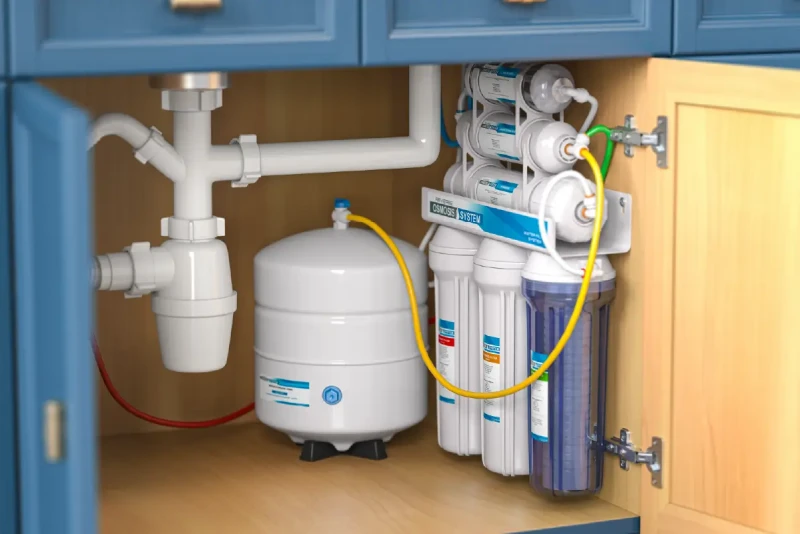
Reverse osmosis systems represent one of the most comprehensive residential water purification methods available. Water is forced under pressure through a semipermeable polyamide membrane with pores measuring roughly 0.0001 microns—thousands of times smaller than a lead ion. The physical size exclusion of the membrane effectively rejects dissolved ionic lead, washing it down the reject drain while delivering purified permeate water to a dedicated storage tank. Point-of-use RO units installed under the kitchen sink frequently incorporate pre-sediment filters, carbon blocks, and post-treatment remineralization stages.
3. KDF (Kinetic Degradation Fluxion) Process Media
KDF process media utilize a high-purity copper-zinc formulation that reduces contaminants via an electrochemical oxidation-reduction (redox) process. When lead-contaminated water contacts the metallic alloy, an electron exchange occurs: soluble lead ions ($Pb^{2+}$) gain electrons, transforming into insoluble metallic lead atoms that physically plate onto the copper-zinc granules. KDF is often paired with carbon blocks to protect the downstream carbon from premature biofouling and chlorine saturation.
Infrastructure Realities and Residential Testing
Installing a certified water filter is a critical line of defense, but it cannot substitute for precise diagnostic analysis of your building’s plumbing integrity. Older urban communities often feature multi-family residential buildings and single-family houses with legacy lead service lines or brass fixtures installed prior to modern code revisions. The only definitive way to confirm lead contamination is through certified laboratory testing of your domestic water.
Conducting professional laboratory analysis—such as checking drinking water for lead in New York City—provides actionable baseline data regarding both initial stagnation spikes (first-draw water) and secondary line migration (flushed water). First-draw samples reveal whether internal plumbing fixtures, shut-off valves, or solder joints are leaching metals into water that sits undisturbed overnight. Subsequent samples evaluate the municipal service connection entering the property.
For comprehensive environmental health guidance, regulatory agencies provide clear warnings regarding domestic dietary pathways. The Food and Drug Administration maintains explicit warnings concerning lead in food and foodwares, reminding families that boiling lead-tainted water does not eliminate the element. In fact, boiling evaporates water volume, significantly concentrating the dissolved heavy metal content. Water used for infant formula, food preparation, and hot beverages must always be sourced cold and filtered through a certified device.
Choosing the Right Filter: Pitcher, Under-Sink, or Whole-House?
Selecting an appropriate treatment configuration requires balancing filtration capacity, maintenance requirements, and structural limitations within your home.
Countertop and Pitcher Filters: Pitchers offer low initial cost and mobility, making them accessible to renters. However, only premium models engineered with ion-exchange composite media hold NSF 53 certification for lead. Standard models must never be assumed to remove heavy metals. Furthermore, small pitcher cartridges require frequent replacement—often every 30 to 40 gallons—making them susceptible to filter exhaustion and contaminant bypass if neglected.
Faucet-Mounted Units: These units attach directly to standard sink spouts and offer convenient toggle switches between unfiltered utility water and filtered drinking water. Many carry verified NSF 53 ratings. However, their flow rates are modest, they do not fit pull-out or non-standard faucet spouts, and accidental use with hot water can strip the chemical binding sites off the filtration media, releasing captured impurities back into the stream.
Under-Sink Point-of-Use (POU) Filters: Under-sink systems, including high-capacity carbon blocks and multi-stage reverse osmosis units, represent the gold standard for residential drinking water protection. Plumbed directly into cold water supply lines, they deliver substantial volume through dedicated lead-free secondary faucets. Their large media surface areas provide optimal water contact time, while advanced multi-stage setups isolate sediment, volatile organic chemicals, and heavy metals separately.
Whole-House (Point-of-Entry) Systems: Whole-house water filters treat all incoming water at the main supply pipe. While effective for sediment and municipal chlorine, standard whole-house units rarely secure NSF 53 certification for lead removal. Treating thousands of gallons of utility water (used for laundry, toilets, and showers) through specialized lead-binding media is economically inefficient. More importantly, because lead often leaches from internal household piping located after the whole-house filter, point-of-use filters directly at the consumption tap remain mandatory.
Property owners considering broad interventions should utilize trusted environmental resources to evaluate the full scope of municipal distribution records, historical building permits, and documented local service lines before committing to costly whole-building filtration setups.
Diagnostic Screening and Professional Guidance
Because particulate lead sheds intermittently, relying on single point-in-time dip strips or uncalibrated test kits yields dangerous false negatives. Consumer test strips rarely possess the analytical detection limit required to register sub-10 ppb concentrations accurately. Working with accredited diagnostic technicians ensures samples follow proper chain-of-custody protocols and are quantified via inductively coupled plasma mass spectrometry (ICP-MS).
For property managers and residents requiring certified testing, scheduled home water testing services in Queens provide verified profiling of both stagnation periods and prolonged flow profiles. Identifying whether lead stems from an off-site utility line or interior fixture solder allows homeowners to implement targeted remediation rather than relying on guesswork.
Federal guidelines from public health institutions, including the CDC lead prevention framework, highlight that primary prevention—identifying and eliminating contamination at the source—remains the only permanent solution to heavy metal hazards. Certified filters serve as vital, interim protective barriers while infrastructure remediation takes place.
Maintenance Protocols: Avoiding Breakthrough and Bacterial Growth
Even the most sophisticated NSF-certified filtration system becomes ineffective—or hazardous—if improperly maintained. No water filter lasts indefinitely. Once the reactive chemical sites on ion-exchange media become saturated with dissolved mineral ions, chemical breakthrough occurs. At this saturation threshold, uncaptured lead passes directly through the outlet.
To maintain operational safety, households must enforce strict operating protocols:
Adhere to Rated Gallon Capacities: Filter lifespan is governed by gallons filtered, not simply elapsed calendar days. Households with high water consumption or high source turbidity will exhaust cartridges long before the manufacturer’s nominal six-month estimate. Modern systems equipped with built-in electronic cycle counters or automatic shut-off valves eliminate reliance on subjective visual inspection.
Flush Cold Water Lines Daily: If a filtration system has sat dormant overnight or through a workday, run cold water through the unit for 30 to 60 seconds prior to collecting water for consumption. This clears standing water that rested in line connections or fixture fittings.
Never Filter Hot Water: Point-of-use drinking water filters are engineered strictly for cold water lines (typically below 85°F to 100°F). Introducing hot water degrades synthetic binding media, dissolves plastic housings, and forces accelerated chemical desorption of previously trapped contaminants.
Sanitize Filter Housings During Cartridge Changes: When swapping old carbon blocks or RO membranes, thoroughly wash and sanitize the sump sumps with a mild food-safe chlorine solution to prevent opportunistic biofilm colonization on the wet surfaces.
For detailed technical inquiries regarding filtration selection or testing methodologies, consulting an environmental testing specialist’s testing FAQ helps demystify local water quality reports and complex laboratory chain-of-custody protocols.
Final Buying Checklist
When choosing a water filter to eliminate heavy metal risks, bypass unsubstantiated marketing claims and verify each parameter against these empirical standards:
1. Verification of NSF/ANSI 53 or 58: Check the official online listings of NSF, WQA, or UL to ensure the system model is explicitly listed for lead reduction under dissolved and particulate challenge matrices.
2. Flow Rate and Gallon Rating: Select a model rated for realistic consumption patterns, factoring in regular cooking, drinking, and pet hydration needs.
3. Automatic Shut-Off / End-of-Life Indicators: Opt for units that mechanically cease water delivery or illuminate unmistakable digital warnings once media saturation points are reached.
4. Certified Component Materials: Confirm NSF/ANSI 372 compliance so all internal housing materials and brass adaptors are independently certified lead-free.
A properly certified water filter is an effective tool against heavy metal ingestion, providing dependable security when municipal and private infrastructure fails. For personalized evaluations of residential water quality, comprehensive lead diagnostics, and actionable environmental health strategies, reach out through the professional contact portal to protect your home’s water safety today.